
- Written June 2, 2026
Summary:
- People often assume Eucalyptus mats only make sense if you fully buy into the longevity story.
- That is not true. Eucalyptus is cheaper on freight even without considering longevity.
- In many jobs, Eucalyptus mats can create a freight advantage large enough to improve economics before you give them any credit for lasting longer.
That matters. Freight is not a side issue in matting. Mats are heavy and relatively cheap – call it roughly $0.20/pound. We’re not shipping raspberries at $5/lb.! The value:mass ratio is low and therefore freight is one of the largest delivered cost components for getting mats to a project. Then you’ve got to move them within a right of way, and bring them home again. If one mat system lets you haul more usable coverage per truck, the economics change fast.
That’s why CLT and composite mats can be such an interesting value proposition. Sure, they don’t have the strength of hardwood mats, but in places that you don’t need the strength they can be a great win.
Freight changes the math
To help customers figure out if Eucalyptus is the right fit for their jobs World Forest Group created a freight calculator that looks at what the impact of freight is on the customer.
Contact us for a private link to the Freight Calculator.
We assume that the customer actually needs Eucalyptus strength.
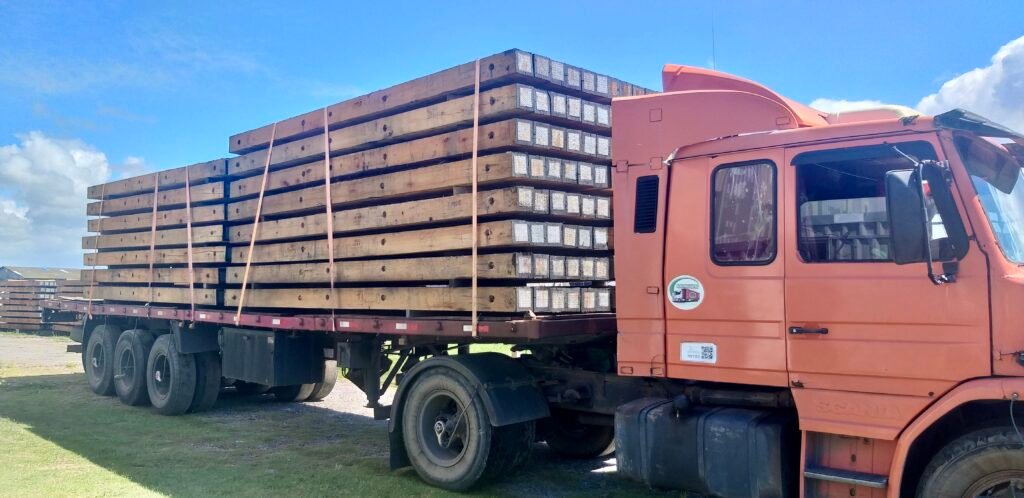
You can win on freight using Eucalyptus because more mats fit on a truck. For 16’ x 4’ x 8” powerline mats, typically you’ll get 18 mixed hardwood mats per truck versus 19 new or 23 seasoned Eucalyptus mats per truck.
(Important note: 10 years ago 18 mats/truck was common and rule of thumb. Over time, species have gotten lighter and dimension is smaller and not true to size thickness or width.)
If you don’t need the strength of an 8” mat, World Forest Group makes 4”, 5”, 6” and 6.75” thick Eucalyptus mats. (The 4” Eucalyptus is roughly equivalent bending strength to a 5-ply CLT. The 6” Eucalyptus is roughly equivalent to an 8-11” mixed hardwood mat.) So, you can use a thinner Eucalyptus mat to substitute a thicker mixed hardwood mat.
We call that substitution “strength-adjusted”. For a strength-adjusted comparison, you can use the conservative end of that range: 16’ x 4’ x 6” Eucalyptus mats at roughly the same bending strength as 8-inch mixed hardwood, with 25 new or 30 seasoned Eucalyptus mats per truck versus 18 mixed hardwood mats.
That difference is not cosmetic. It means fewer truckloads to deliver the same number of mats, fewer truckloads to reposition mats inside a right of way, and fewer truckloads every time those mats are moved again. On jobs with multiple internal moves or sublet cycles (if you are leasing), freight savings compound instead of staying flat.
Why mat renters should care? Check the Calculator.
Freight advantage matters even if you never own the mat. A renter still pays for delivered economics one way or another, whether freight is itemized on the invoice, folded into the rate, or absorbed into the bid.
You can see when you run the calculator. The default freight view includes long-haul trucking, within-right-of-way moves, repeat moving cycles, and markup on billed freight. Eucalyptus creates freight margin opportunities because more mats fit per truck and you can control those moves.
In a default 1,000-mat comparison, the economics are driven by:
- Mats per truck,
- Truckload cost,
- Freight markup,
- Within-ROW move cost,
- Moves per cycle, and
- Actual mat width.
Typical mixed hardwood is 18 mats per truck while eucalyptus is 23, reducing truckload cost from $56/mat to $44/mat and increasing total freight margin from $7,000 to $19,000, a $12,000 advantage. In that same comparison, freight margin rises from $26.04/mat to $71.33/mat per mat, while true-to-size 48-inch eucalyptus coverage cuts the required mat count from 1,000 to 896 for the same ROW, saving 104 mats.
Even before you think about Eucalyptus longevity you can make more money using Eucalyptus’ freight and true-to-size economics.
More mats per truck is not the whole story – Don’t believe us; believe your own measurements
Freight advantage exists because Eucalyptus mats are not just lighter on paper. You can weigh them yourself. All World Forest Group’s product line is true-size manufacturing not “nominal” dimensions. You can measure them yourself.
This is where buyers often miss the real issue. They compare purchase price per mat instead of freight-adjusted delivered cost per mat. A mat is not a mat if one option lets you move substantially more and wider mats every time a truck rolls. (The composite and CLT manufacturers know this, too.)
Freight gets bigger as jobs get messier
The longer and more active the project is, the more freight matters. Jobs with multiple spreads, internal moves, weather delays, and reuse cycles magnify the advantage of fitting more mats on every load.
That is why freight can be a good reason on its own to choose Eucalyptus, not just a side benefit behind longevity. Longevity still matters, and World Forest Group’s field-use and customer use data show Eucalyptus mats can often last about 7 to 9 years under typical conditions. See the testing page and the article “How Long Does a Eucalyptus Mat Last”.
But even before a buyer accepts longevity, freight alone can move the economics in Eucalyptus’s favor.
What a buyer should compare summary?
If you want a fair comparison, do not stop at price per mat. Compare:
• Mats per truck.
• Delivered cost per mat.
• Delivered cost per foot or mile of coverage.
• Number of internal ROW moves expected.
• Number of redeployments or sublet cycles.
• Whether the comparison is true size mats a full 48”, or whether one mat is narrower than nominal 48”.
Those are the variables that decide whether mixed hardwood is truly cheaper or only looks cheaper before the trucks start moving.
Closing
The simplest way to say it is this: You don’t need to believe in Eucalyptus mats’ longevity for Eucalyptus to be economically interesting. If more mats fit on each truck, freight alone can make Eucalyptus the better buy or the better rental choice on the right job.
FAQs
Yes. Eucalyptus mats load 23 per truck versus 18 for mixed hardwood on a standard 16′ x 4′ x 8″ powerline mat comparison. On a 1,000-mat job, that difference reduces truckloads from 56 to 44 and can add $12,000 in freight margin — before longevity is factored in at all.
A 6-inch Eucalyptus mat delivers roughly the same bending strength as an 8-inch to 11-inch mixed hardwood mat. That strength-adjusted swap also improves the truck count further from 18 hardwood mats per truck to 25 new or 30 seasoned Eucalyptus mats per truck.
Yes. Renters pay delivered economics one way or another — freight is either itemized on the invoice, folded into the rate, or absorbed into the bid. More mats per truck means lower cost per mat moved, whether you own them or not.
Every internal right-of-way move, sublet cycle, or redeployment triggers another round of trucking. Because Eucalyptus loads more mats per truck each time, the freight advantage multiplies with every move rather than staying flat.
Compare delivered cost per mat, delivered cost per foot or mile of ROW coverage, mats per truck, number of expected internal moves, redeployment cycles, and whether you’re comparing true 48-inch Eucalyptus mats or nominal-width mats that are actually narrower.