
How long do Eucalyptus mats last – revised December 30, 2025
Summary
- Eucalyptus timber mats can often last about 7–10 years in harsh, muddy conditions when handled with reasonable care, outperforming many traditional timber mats.
- A 6.5‑year real‑world test showed Eucalyptus timber mats remained dense and strong enough to be remanufactured into new ground protection mats, extending their useful lifespan.
- Flip tests with 700 handling cycles demonstrated that remanufactured Eucalyptus timber mats stay functional under heavy forklift abuse, providing durable, long‑lasting ground protection for construction and energy projects.
How Long Do Eucalyptus Mats Last?
How long do Eucalyptus mats really last?
Eucalyptus mat lifespan depends on machinery, ground conditions, handling, and basic mat care. There are still good ways to estimate real‑world Eucalyptus mat lifespan. Here’s the short video version below. Keep reading for more detail on how long these mats last in the field, how they behave when remanufactured, and what this means for your projects.
Why This Longevity Test Matters
Checking whether the raw material is still sound after many years under load is an excellent proxy. It helps predict Eucalyptus timber mats longevity. If the wood remains dense, strong, and free of significant defects, those mats can often be remanufactured instead of discarded.
Typical timber mats fail because they use lower‑strength species such as poplar or gum. They also have defects like rot, wane, and poor geometry.
To understand how long Eucalyptus mats last compared to conventional timber mats, pay close attention to the wood quality in the videos and photos. The contrast in fiber strength and durability is what drives longer mat life.
Real-World Test: 6.5 Years in the Mud
Manufacturing of the first batch of Eucalyptus timber mats was in May 2016 as 18’x4’x8″ pipeline mats. These were version 1, where the 16′ timber sat in the second position. And, they were reject mats from our first batches. Those mats served as a temporary road outside World Forest Group’s manufacturing facility and retired in January 2023 after 6.5 years.
Operating and environmental conditions were harsh: 90,000 lb log trucks plus fully loaded forklifts, in rain, and high humidity. Temperatures almost identical to coastal Mississippi. The mats sat in mud constantly during that entire period, providing a realistic test of their lifespan in difficult conditions.
Instead of composting the retired mats with a nearby farmer, the team experimented. They tested whether those 6.5‑year‑old Eucalyptus timbers could be remanufactured into new Eucalyptus ground protection mats.
Remanufacturing Old Eucalyptus Mats
Here is what was done with the old mats after more than six years of use:
-
Trimmed the timbers to length for the new mat configuration.
-
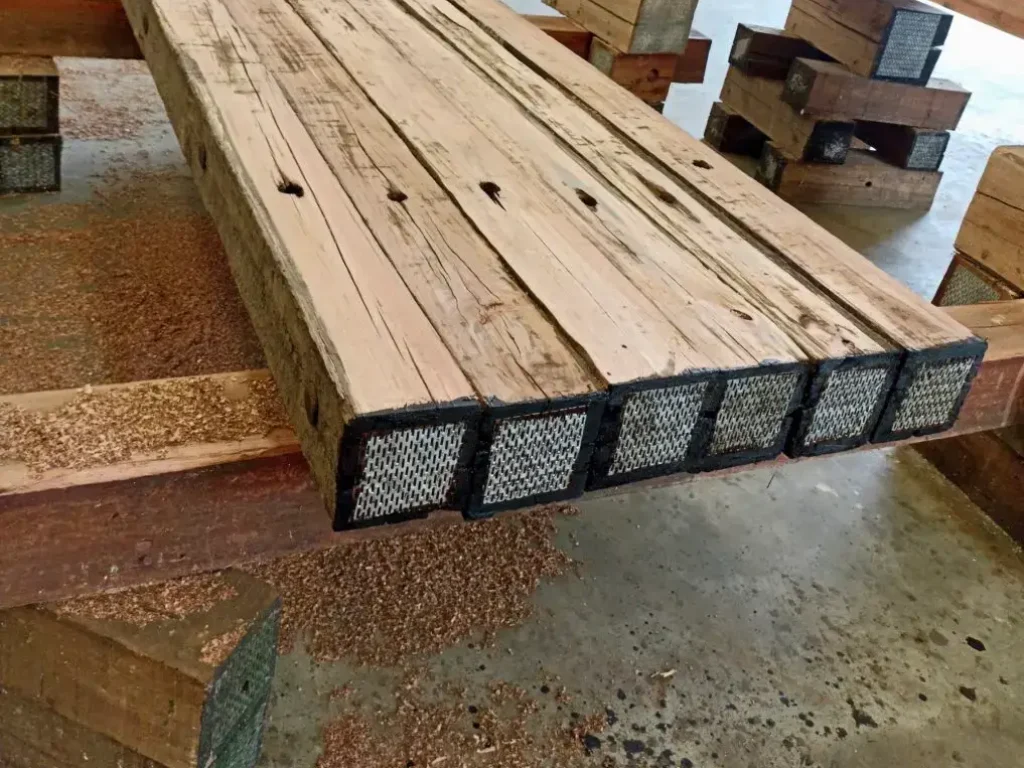
Planed the surface to expose fresh wood and review internal quality.
-
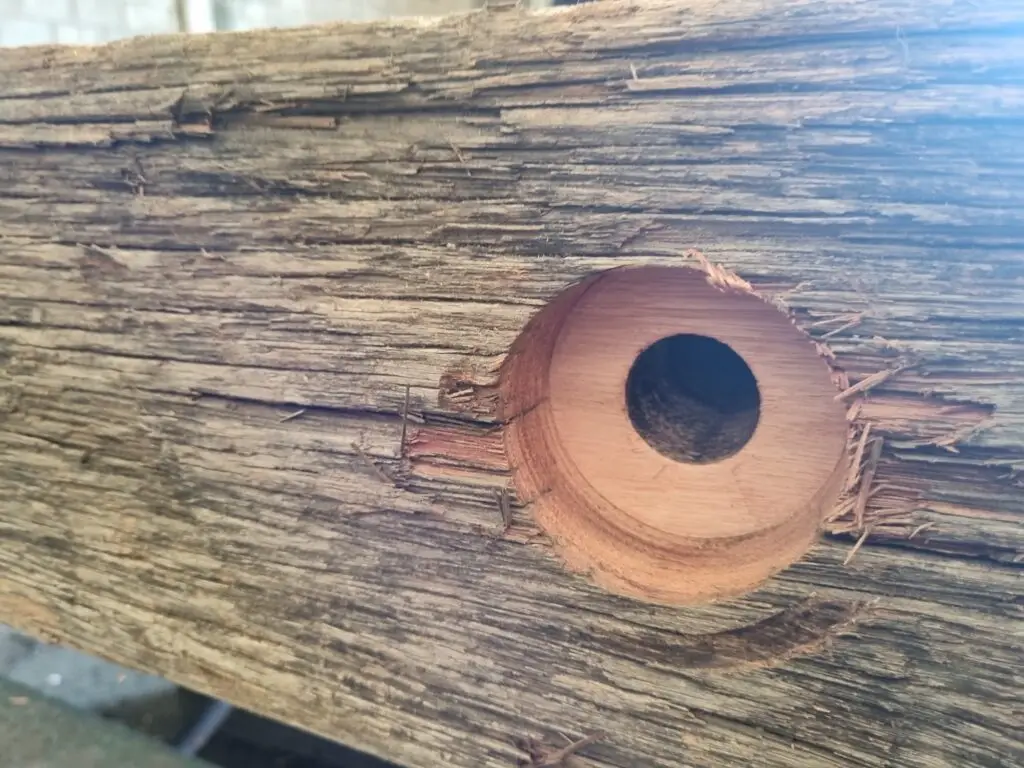
Drilled new bolt holes to match the updated layout.
-
Added end sealant and plates to protect the fiber and extend mat lifespan.
A short chainsaw video shows the original mat being broken down. A set of images illustrates the process from old mat to finished timber. In each step, the wood remains clean and strong. That is remarkable for Eucalyptus timbers that spent 6.5 years in the mud.

Flip Test: 700 Handling Cycles
Most mat damage comes from handling, not static loading. Forklifts can be particularly rough on mats if operators rush lifts, drop mats, or drag them across the ground.
To simulate that abuse, we put a remanufactured Eucalyptus mat through a flip test:
-
The test mat was flipped 700 times to approximate long‑term handling damage.
-
The mat survived intact through all 700 flips.
-
Two of the 6.5‑year‑old timbers cracked, but the mat held together and remained functional.
Flipping test mats hundreds of times is a good proxy for estimating damage from handling. Flipping helps answer how long these mats last when you move them frequently. If you would like to see photos of the flipped mat after 100, 200, 300, 400, 500, 600, and 700 flips, contact us.
So How Long Do Eucalyptus Mats Last?
So, how long will an 8″ Eucalyptus mat last? Under similar operating, handling, and environmental conditions, the answer is often in the 7–10 year range, assuming reasonable care and handling.
That kind of Eucalyptus mat lifespan comes from pairing high‑strength Eucalyptus fiber with better geometry. Precision manufacturing also plays a key role. Compared to lower‑strength species used in traditional timber mats, long‑lasting Eucalyptus ground protection mats can deliver more years of service and better value per project.
World Forest Group now manufactures a Version 9 pipeline mat with two configurations: a mini‑notch version and a solid mat with lifting straps, both substantially stronger than the original version 1 design. These newer configurations build on what the field data showed and customer feedback provided about wood performance, handling damage, and long‑term durability.
To learn more about how Eucalyptus timber mats work across different sites and industries, explore the overview on Eucalyptus timber mats or the Resources on benefits of Eucalyptus timber mats for ground protection. For project‑specific questions about how long Eucalyptus mats may last on your job, look at our purchasing guide or contact us to discuss details.
Frequently Asked Questions
As low as one year; as high as 7-9 years. Timber mats have radically different lifespans depending on species, grade, environmental and jobsite conditions, and how carefully they are handled and stored. Eucalyptus mats consistently perform at the higher end of that range. In 2026 the biggest issues on shorter-lived mats seems to be rot and lack of rot-resistant species and grades.
Eucalyptus is a dense, tight-grained hardwood with natural oils that resist rot. Mixed hardwood mats vary in species, grade, and defect levels from load to load, which creates inconsistent field performance. Eucalyptus mats are uniform by species and grade, which translates directly to longer service life.
The most common causes are species and grade defects. For example, some species are prone to rot. After species come improper handling (e.g., forklift damage to the face), repeated wet/dry cycling without proper drying and storage, overloading beyond the mat’s load rating, and low-grade or defect-heavy material in the original product. Species choice matters; lower-stength species simply compress and split faster under heavy equipment. After that comes dimension. A 7” thick timber mat, which should be 8” isn’t 1/8th weaker; it’s about ¼ weaker because bending strength is a function of the square of the thickness.
Yes. Mats with isolated damage — broken timbers and loose bolts can often be repaired in the field or in the yard. Bolts should be tightened every two years, but typically they aren’t because many mats simply don’t last long enough to spend the money. Structural damage from damaged timbers typically means end of service life. Eucalyptus mats tend to reach end of life more uniformly, making the refurbishment decision more straightforward.
A lower-cost mat that lasts two years requires roughly 3+ replacement cycles over a 7-year period, meaning you spend 3x the purchase price plus mobilization, handling, and downtime costs each cycle. A higher-quality Eucalyptus mat at a higher upfront price frequently delivers a lower total cost of ownership when calculated over the full project or fleet lifecycle.