
Date: May 13, 2026
Summary:
- Eucalyptus mats look expensive if the only number you compare is purchase price.
- That is the wrong number.
- The right number is total cost of ownership: purchase price, freight, lifespan, replacement, failure risk, handling, and performance.
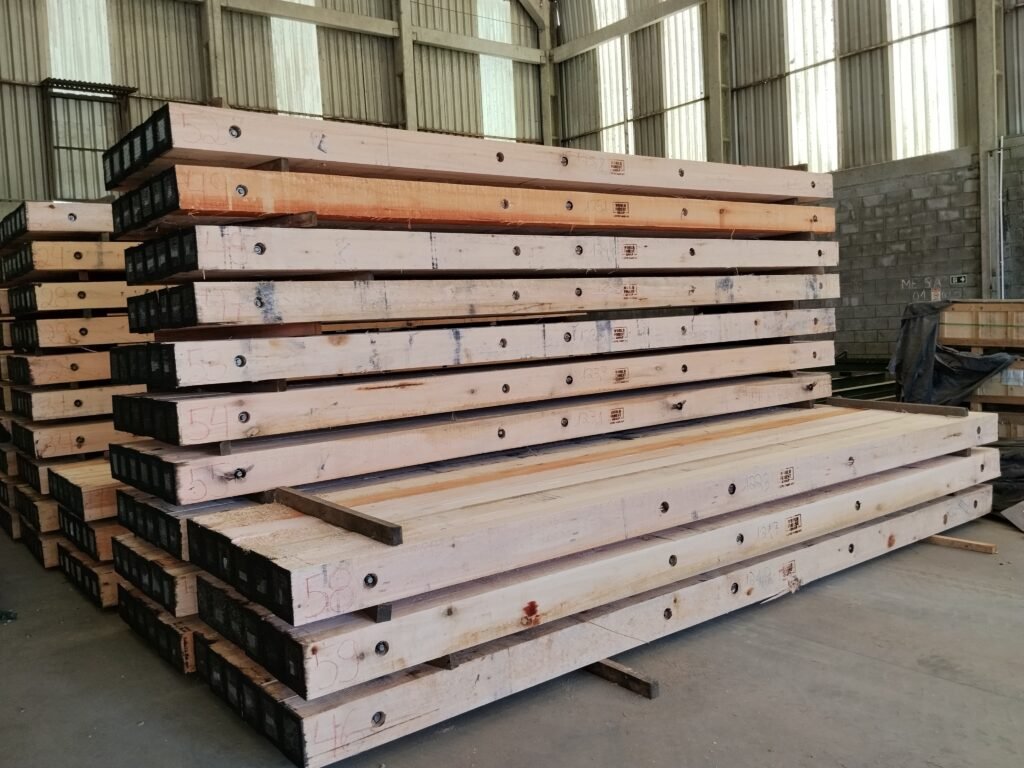
Once you run that math, WFG Eucalyptus mats start looking like the premium machine that finishes the job while the cheap machine waits for parts.
Think Caterpillar versus a generic import. The cheaper machine may move dirt on day one. The premium machine is built for uptime, reliability, resale, and cost per productive hour. Timber mats work the same way.
Premium Costs More Than Cheap. That Does Not Make It Expensive.
WFG’s crane mat guide compares an 18′ x 4′ x 12″ Eucalyptus mat at $1,200 with a 60-month lifespan against a mixed hardwood #2 mat at $975 with a 21-month lifespan. Monthly depreciation is $20.00 for Eucalyptus and $46.43 for mixed hardwood #2.
In other words, the higher-priced mat costs less per month of use.
That is the heart of the Eucalyptus value argument. If a buyer saves money on day one and then buys replacement mats sooner, the savings are delayed cost.
Nine Differences That Change the Real Price
| Differentiator | WFG Eucalyptus | Mixed Hardwood |
|---|---|---|
| Warranty and guarantee | ✓ 10-point manufacturer’s warranty | ✗ No warranty terms |
| Raw material | ✓ 100% plantation Eucalyptus, never mixed species | ✗ Mixed hardwood is a marketing name, not a species designation |
| Grade of timbers | ✓ #1 and better |
✗ Usually #2, sometimes #3. ✓ Occasionally #1 oak at premium price. |
| Manufacturing quality | ✓ Dedicated precision manufacturing, square timbers, dimensional accuracy, uniform bolt placement, bar coding, and WFG branding | ✗ Quality depends on supplier, sawmill output, species mix, grade, and defects |
| Defect policy | ✓ No wane, square timbers, fresh timber, true-to-size, real 48” wide, real thickness | ✗ Wane, bark, round timbers typical |
| Rot and weather resistance | ✓ Rot resistant. Freeze tested in field and lab | ✗ Rot common. Other resistance varies by species |
| Bolt standards | ✓ ASTM F1554 Grade 36+ bolts in every mat | ✗ Commodity carriage bolts |
| End treatment | ✓ Metal end (truss) plates and end sealing | ✗ No plates, usually painted not end sealed. |
| Truss or end plates | ✓ Metal end plates for strength and integrity. Worldwide best practice for timbers construction | ✗ None. |
Raw Material Is the Starting Point
Manufacturing Quality Is Not a Detail
Freight and Replacement Are Part of the Price
Cheap Mats Are Often Expensive in Disguise
Frequently Asked Questions
The purchase price is higher. The cost is not. When you calculate total cost of ownership, which includes purchase price, freight, lifespan, replacement cycles, and handling, Eucalyptus mats typically cost less per month of service than mixed hardwood alternatives. A WFG Eucalyptus crane mat at $1,200 with a 60-month lifespan depreciates at $20/month. A mixed hardwood #2 mat at $975 with a 21-month lifespan depreciates at $46/month. The “cheaper” mat costs more than twice as much per month of use.
Nine documented differences: a 10-point manufacturer’s warranty, 100% plantation Eucalyptus (single known species), #1-and-better grade timbers, precision manufacturing with dimensional accuracy and bar coding, no wane or bark, rot resistance and freeze-tested performance, ASTM F1554 Grade 36+ bolts (not commodity carriage bolts), metal end/truss plates, and USDA phytosanitary treatment. Mixed hardwood mats typically have none of these documented differences. The quality depends entirely on what the supplier ships.
Very little. Mixed hardwood is a marketing name, not a species designation. It does not tell the buyer the species mix, grade, bending strength, defect limits, hardware grade, or manufacturing tolerances. Typical mixed hardwood mats now use #2 and #3 timbers with a bending strength of 550 psi or less. WFG Eucalyptus has 2,000 psi bending strength. That is not a minor difference — it is the difference between a mat that performs at the edge of its limits and one with real structural performance and safety reserve.
Eucalyptus mats are stronger and 10% lighter brand new. After six months of moisture loss, you can ship about 25% more mats per truck than typical mixed hardwood mats. More mats per truck means lower freight cost per mat every time the fleet moves. When you are replacing a mixed hardwood mat every 18–24 months versus keeping a Eucalyptus mat in service for five to seven years, you are also paying freight again and again on the replacement cycles. That cost never appears on the original purchase order, but it shows up on the jobsite.
Do not stop at price per mat. The right comparison is cost per month of service or depreciation cost. Include documented bending strength, grade and defect policy, hardware specification (bolt grade and end plate treatment), rot and weather resistance, and what happens two, three, four, and five years from now. A mat that requires replacement in year two has already erased any day-one savings through repurchase, freight, and handling costs plus the downtime risk of a mat failing in the field.
Strength adjusted Eucalyptus mats are your answer. Because Eucalyptus is 200-300% stronger you can use a thinner Eucalyptus mat instead of a thicker mixed hardwood mat and still get the same bending strength.
For example, with current #2 mixed hardwood timbers you’d need an 8.5” – 11” mixed hardwood mat to be as strong as a 6” Eucalyptus mat. You’ll also save a lot of money in truck freight. 16’x4’x6” Eucalyptus mats are 25 mats/flatbed when new and 30 mats/flatbed after 6 months. A 16’x4’x8” mixed hardwood is 18 mats/truck. On a $1000 haul that saves you $15/mat new and $22/mat after six months. And the 6” Eucalyptus mat runs about $100/mat less than an 8” Eucalyptus mat.